
Helpful Tools & Resources

INCOTERMS

The Incoterms or International Commercial Terms are a series of pre-defined commercial terms published by the International Chamber of Commerce (ICC) relating to international commercial law.
 Read more

The incoterms define the role between seller and buyer at an international transaction. The Incoterms 2010 rules are standard sets of trading terms and conditions designed to assist traders when goods are sold and transported.

Each Incoterms rule specifies:
  • the obligations of each party (e.g. who is responsible for services such as transport; import and export clearance etc)
  • the point in the journey where risk transfers from the seller to the buyer

So by agreeing on an Incoterms rule and incorporating it into the sales contract, the buyer and seller can achieve a precise understanding of what each party is obliged to do, and where responsibility lies in event of loss, damage or other mishap.

The eleven rules are divided into two main groups

Rules for any transport mode
  • Ex Works EXW
  • Free Carrier FCA
  • Carriage Paid To CPT
  • Carriage & Insurance Paid to CIP
  • Delivered At Terminal DAT
  • Delivered At Place DAP
  • Delivered Duty Paid DDP
 
Rules for sea & inland waterway only
  • Free Alongside Ship FAS
  • Free On Board FOB
  • Cost and Freight CFR
  • Cost Insurance and Freight CIF
 
In general the “transport by sea or inland waterway only” rules should only be used for bulk cargos (e.g. oil, coal etc) and non-containerised goods, where the exporter can load the goods directly onto the vessel. Where the goods are containerised, the “any transport mode” rules are more appropriate.

Free Carrier (FCA)

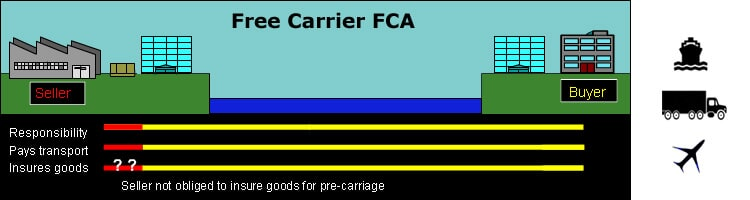
Can be used for any transport mode, or where there is more than one transport mode.
A very flexible rule that is suitable for all situations where the buyer arranges the main carriage.
In all cases, the seller is responsible for export clearance; the buyer assumes all risks and costs after the goods have been delivered at the named place.
Free Carrier (FCA)

Can be used for any transport mode, or where there is more than one transport mode.
A very flexible rule that is suitable for all situations where the buyer arranges the main carriage.
In all cases, the seller is responsible for export clearance; the buyer assumes all risks and costs after the goods have been delivered at the named place.
Carriage Paid To (CPT)

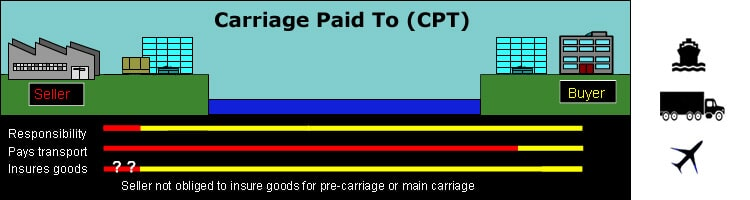
Can be used for any transport mode, or where there is more than one transport mode.
The seller is responsible for arranging carriage to the named place, but not for insuring the goods to the named place. However delivery of the goods takes place, and risk transfers from seller to buyer, at the point where the goods are taken in charge by a carrier.
Carriage and Insurance Paid To (CIP)

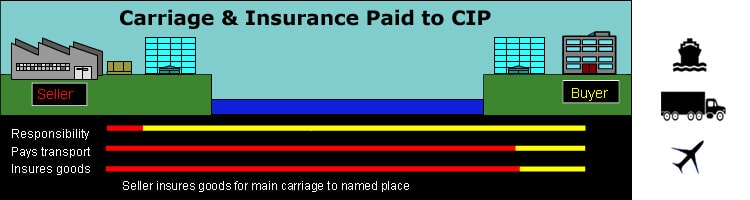
Can be used for any transport mode, or where there is more than one transport mode.
The seller is responsible for arranging carriage to the named place, and also for insuring the goods. As with CPT, delivery of the goods takes place, and risk transfers from seller to buyer, at the point where the goods are taken in charge by a carrier
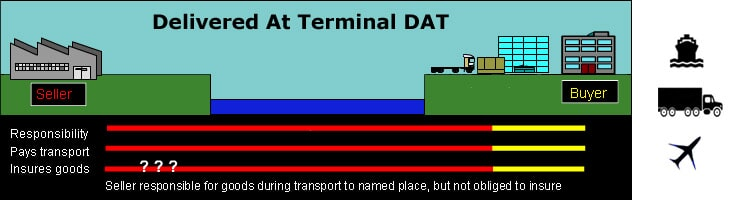
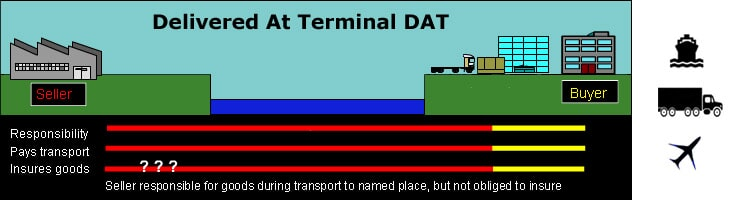
Delivered at Terminal (DAT)

Can be used for any transport mode, or where there is more than one transport mode.
The seller is responsible for arranging carriage and for delivering the goods, unloaded from the arriving conveyance, at the named place.
Risk transfers from seller to buyer when the goods have been unloaded.
‘Terminal’ can be any place – a quay, container yard, warehouse or transport hub.
The buyer is responsible for import clearance and any applicable local taxes or import duties.
Delivered at Place (DAP)

Can be used for any transport mode, or where there is more than one transport mode. The seller is responsible for arranging carriage and for delivering the goods, ready for unloading from the arriving conveyance, at the named place. (An important difference from Delivered At Terminal DAT, where the seller is responsible for unloading.)
Risk transfers from seller to buyer when the goods are available for unloading; so unloading is at the buyer’s risk.
The buyer is responsible for import clearance and any applicable local taxes or import duties.
This rule can often be used to replace the Incoterms 2000 rules Delivered At Frontier (DAF), Delivered Ex Ship (DES) and Delivered Duty Unpaid (DDU)
Delivered Duty Paid (DDP)

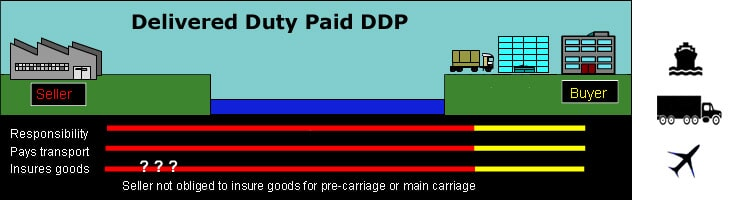
Can be used for any transport mode, or where there is more than one transport mode.
The seller is responsible for arranging carriage and delivering the goods at the named place, cleared for import and all applicable taxes and duties paid (e.g. VAT, GST).
Risk transfers from seller to buyer when the goods are made available to the buyer, ready for unloading from the arriving conveyance.
This rule places the maximum obligation on the seller, and is the only rule that requires the seller to take responsibility for import clearance and payment of taxes and/or import duty.
Free Alongside Ship (FAS)

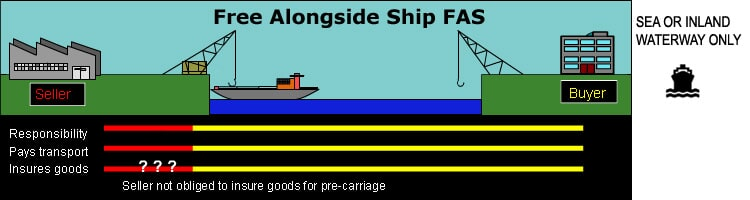
Use of this rule is restricted to goods transported by sea or inland waterway.
In practice it should be used for situations where the seller has direct access to the vessel for loading, e.g. bulk cargos or non-containerised goods.
For containerised goods, consider “Free Carrier FCA” instead.
Seller delivers goods, cleared for export, alongside the vessel at a named port, at which point risk transfers to the buyer.
The buyer is responsible for loading the goods and all costs thereafter.
Free On Board (FOB)

Use of this rule is restricted to goods transported by sea or inland waterway.
In practice it should be used for situations where the seller has direct access to the vessel for loading, e.g. bulk cargos or non-containerised goods.
For containerised goods, consider “Free Carrier FCA” instead.
Seller delivers goods, cleared for export, loaded on board the vessel at the named port.
Once the goods have been loaded on board, risk transfers to the buyer, who bears all costs thereafter.
FOB
Cost and Freight (CFR)

Use of this rule is restricted to goods transported by sea or inland waterway.
In practice it should be used for situations where the seller has direct access to the vessel for loading, e.g. bulk cargos or non-containerised goods.
For containerised goods, consider ‘Carriage Paid To CPT’ instead.
Seller arranges and pays for transport to named port. Seller delivers goods, cleared for export, loaded on board the vessel.
CFR
Cost Insurance and Freight (CIF)

Use of this rule is restricted to goods transported by sea or inland waterway.
In practice it should be used for situations where the seller has direct access to the vessel for loading, e.g. bulk cargos or non-containerised goods.
For containerised goods, consider ‘Carriage and Insurance Paid CIP’ instead.
Seller arranges and pays for transport to named port. Seller delivers goods, cleared for export, loaded on board the vessel.
Seller also arranges and pays for insurance for the goods for carriage to the named port.

GLOSSARY OF LOGISTICS, PORT & SHIPPING TERMS

Air Cargo: Freight that is moved by air transportation.
Air Carrier: An enterprise that offers transportation service via air.
Air Waybill (AWB): A bill of lading for air transport that serves as a receipt for the shipper, indicates that the carrier has accepted the goods listed, obligates the carrier to carry the consignment to the airport of destination according to specified conditions.
Bill of Lading (BOL): A transportation document that is the contract of carriage containing the terms and conditions between the shipper and carrier.
 Read more

Bill of Lading Number: The number assigned by the carrier to identify the bill of lading.
Breakbulk: Loose, noncontainerized cargo stowed directly into a ship’s hold.
Buyer: An enterprise that arranges for the acquisition of goods or services and agrees to payment terms for such goods or services.
Cargo: Merchandise carried by a means of transportation.
Cargo Tonnage: Ocean freight is frequently billed on the basis of weight or measurement tons. Weight tons can be expressed in terms of short tons of 2,000 pounds, long tons of 2,240 pounds, or metric tons of 1,000 kilograms (2,204.62 pounds). Measurement tons are usually expressed as cargo measurements of 40 cubic feet (1.12 cubic meters) or cubic meters (35.3 cubic feet).
Carrier: A firm that transports goods or people via land, sea, or air.
Carrier Liability: A common carrier is liable for all shipment loss, damage, and delay with the exception of that caused by act of God, act of a public enemy, act of a public authority, act of the shipper, and the goods' inherent nature.
Cartage: Intraport or local hauling of cargo by drays or trucks (also referred to as drayage).
Collect Freight: Freight payable to the carrier at the port of discharge or ultimate destination. The consignee does not pay the freight charge if the cargo does not arrive at the destination.
Combined Demurrage & Detention (also called merged D&D): The charge related to the use of equipment only, the Merchant pays for carrier’s equipment kept beyond the free time offered by the Carrier, when Demurrage and Detention is combined into one single period.
Consignee: The party to whom goods are shipped and delivered. The receiver of a freight shipment.
Consolidation: Combining two or more shipments in order to realize lower transportation rates. Inbound consolidation from vendors is called make-bulk consolidation; outbound consolidation to customers is called break-bulk consolidation.
Container: (1) A box, typically 10 to 40 feet long, which is primarily used for ocean freight shipments. For travel to and from ports, containers are loaded onto truck chassis or on railroad flatcars. (2) The packaging, such as a carton, case, box, bucket, drum, bin, bottle, bundle, or bag, that an item is packed and shipped in.
Container Depot: The storage area for empty containers.
Container Freight Station (CFS): The location designated by carriers for receipt of cargo to be packed into containers/equipment by the carrier. At destination, CFS is the location designated by the carrier for unpacking of cargo from equipment/containers.
Container Freight Station to Container Freight Station (CFS/CFS): A type of steamship-line service in which cargo is transported between container freight stations, where containers may be stuffed, stripped, or consolidated. Usually used for less-than-container load shipments.
Container I.D.: An identifier assigned to a container by a carrier.
Container Yard: A container handling and storage facility either within a port or inland.
Cost, Insurance, Freight: A freight term indicating that the seller is responsible for cost, the marine insurance, and the freight charges on an ocean shipment of goods.
Country of Destination: The country that will be the ultimate or final destination for goods.
Country of Origin: The country where the goods were manufactured.
Courier Service: A fast, door-to-door service for high-valued goods and documents; firms usually limit service to shipments weighing fifty pounds or less.
Crane: A materials handling device that lifts heavy items. There are two types: bridge and stacker.
Customs: A government service which is responsible for the administration of Customs law and the collection of duties and taxes and which also has the responsibility for the application of other laws and regulations relating to the importation, exportation, movement or storage of goods.
Customs Broker: A firm that represents importers/exporters in dealings with customs. Normally responsible for obtaining and submitting all documents for clearing merchandise through customs, arranging inland transport, and paying all charges related to these functions.
Customs Clearance: The act of obtaining permission to import merchandise from another country into the importing nation.
Customs Declaration: An official document that lists and gives details of goods that are being imported or exported, whereby a person indicates the wish to place goods under a given customs procedure.
Customs Value: The value of the imported goods on which duties will be assessed.
Cycle Inventory: An inventory system where counts are performed continuously, often eliminating the need for an annual overall inventory. It is usually set up so that A items are counted regularly (i.e., every month), B items are counted semi-regularly (every quarter or six months), and C Items are counted perhaps only once a year.
Dangerous Goods: Articles or substances capable of posing a significant risk to health, safety, or property, and that ordinarily require special attention when transported.
Delivery Order: A document issued by the customs broker to the ocean carrier as authority to release the cargo to the appropriate party.
Demurrage: The charge, related to the use of the equipment only, the Merchant pays for carrier's equipment kept beyond the free time offered by the Carrier for taking delivery of goods in the port, terminal or depot.
Detention: The charge the Merchant pays for detaining Carrier's equipment outside the port, terminal or depot, beyond the free time.
Door to Door: The through-transport of goods from consignor to consignee.
Door to Port: The through transport service from consignor to port of importation.
Duty: A tax imposed by a government on merchandise imported from another country.
ETA: The Estimated Time of Arrival.
ETD: The Estimated Time of Departure.
Export: To send goods and services to another country.
Export Declaration: A document required by the U.S. Treasury department and completed by the exporter to show the value, weight, consignee, destination, etc., pertinent to the export shipment. The document serves two purposes: to gather trade statistics and to provide a control document if the goods require a valid export license.
Export License: A document secured from a government authorizing an exporter to export a specific quantity of a controlled commodity to a certain country. An export license is often required if a government has placed embargoes or other restrictions upon exports.
Final Destination: The last stopping point for a shipment.
First In First Out (FIFO): In inventory control and financial accounting, this refers to the practice of using stock from inventory on the basis of what was received first and is consumed first.
Flight Number: An identifier associated with the air equipment (plane). Typically a combination of two letters, indicating the airline, and three or four digits indicating the number of the voyage.
FOB Destination: Title passes at destination, and seller has total responsibility until shipment is delivered.
FOB Origin: Title passes at origin, and buyer has total responsibility over the goods while in shipment.
Force Majeure: The title of a common clause in contracts, exempting the parties from nonfulfillment of their obligations as a result of conditions beyond their control, such as earthquakes, floods, or war.
Forklift Truck: A machine-powered device used to raise and lower freight and to move freight to different warehouse locations.
Forty-Foot Equivalent Unit (FEU): Unit of measurement equivalent to one forty-foot container. Two twenty-foot containers (TEUs) equal one FEU.
Free Time: The period of time offered by the Carrier to the Merchant free of charge, covering both demurrage period and detention period, beyond which additional charges such as, but not limited to demurrage and detention charges, will be due to the Carrier.
Freight: Goods being transported from one place to another.
Freight Carriers: Companies that haul freight, also called "for-hire" carriers. Methods of transportation include trucking, railroads, airlines, and sea borne shipping.
Freight Charge: The rate established for transporting freight.
Freight Collect: The freight and charges to be paid by the consignee.
Freight Consolidation: The grouping of shipments to obtain reduced costs or improved utilization of the transportation function. Consolidation can occur by market area grouping, grouping according to scheduled deliveries, or using third party pooling services such as public warehouses and freight forwarders.
Freight Forwarder: An organization which provides logistics services as an intermediary between the shipper and the carrier, typically on international shipments. Freight forwarders provide the ability to respond quickly and efficiently to changing customer and consumer demands and international shipping (import/export) requirements.
Freight Payable at Destination: Method of paying the freight often used for shipment of bulk cargo, the weight of which is established on discharge from the ship.
Freight Prepaid: The freight and charges to be paid by the consignor.
Gross Weight: The total weight of the vehicle and the payload of freight or passengers.
Handling Costs: The cost involved in moving, transferring, preparing, and otherwise handling inventory.
Harbor Dues (or Port Dues): Charges by a port authority to a vessel for each harbor entry, usually on a per gross tonnage basis, to cover the costs of basic port infrastructure and marine facilities such as buoys, beacons, and vessel traffic management system.
Harmonized Commodity Description & Coding System (Harmonized Code): An international classification system that assigns identification numbers to specific products. The coding system ensures that all parties in int'l. trade use a consistent classification for the purposes of documentation, statistical control, and duty assessment.
Haulage: The inland transport service which is offered by the carrier under the terms and conditions of the tariff and of the relative transport document.
Hazardous Goods: Articles or substances capable of posing a significant risk to health, safety, or property, and that ordinarily require special attention when transported. Also called Dangerous Goods.
House Air Waybill (HAWB): A bill of lading issued by a forwarder to a shipper as a receipt for goods that the forwarder will consolidate with cargo from other shippers for transport.
Import: Movement of products from one country into another. The import of automobiles from Germany into the US is an example.
Importation Point: The location where goods will be cleared for importation into a country.
Import/Export License: Official authorization issued by a government allowing the shipping or delivery of a product across national boundaries.
Inbound logistics: The management of materials from suppliers and vendors into production processes or storage facilities.
Insurance: A system of protection against loss under which a number of parties agree to pay certain sums (premiums) for a guarantee that they will be compensated under certain conditions for specified loss and damage.
Insurance Certificate: A document issued to the consignee to certify that insurance is provided to cover loss of or damage to the cargo while in transit.
Inventory: Raw materials, work in process, finished goods, and supplies required for creation of a company's goods and services. The number of units and/or value of the stock of goods held by a company.
Issuing Carrier: The carrier whose name is printed on the bill of lading and with whom the contract of carriage exists.
Key Performance Indicator (KPI): A measure which is of strategic importance to a company or department. For example, a supply chain flexibility metric is Supplier On-Time Delivery Performance which indicates the percentage of orders that fulfilled on or before the original requested date.
Lading: The cargo carried in a transportation vehicle.
Last In First Out (LIFO): In inventory control and financial accounting, this refers to the practice of using stock from inventory on the basis of what was received last is consumed first. This has limited use in stock keeping and is primarily a cost-accounting method.
Lift-On Lift-Off (Lo-Lo): Cargo handling method by which vessels are loaded or unloaded by either ship or shore cranes.
Less-Than-Carload (LCL): Shipment that is less than a complete rail car load (lot shipment).
Less-Than-Containerload (LCL): A term used when goods do not completely occupy an entire container. When many shipper's goods occupy a single container, each shipper's shipment is considered to be LCL.
Less-Than-Truckload (LTL) Carriers: Trucking companies that consolidate and transport smaller (less than truckload) shipments of freight utilizing a network of terminals and relay points.
Less-Than-Truckload (LTL): Trucking companies that consolidate and transport smaller (less than truckload) shipments of freight by utilizing a network of terminals and relay points.
Logistics: The process of planning, implementing, and controlling procedures for the efficient and effective storage of goods, services, and related information from the point of origin to the point of consumption for the purpose of conforming to customer requirements. This definition includes inbound, outbound, internal, and external movements.
Marks and Numbers: Marks and numbers placed on goods used to identify a shipment or parts of a shipment.
Master Air Waybill (MAWB): The bill of lading issued by air carriers to their customers.
Minimum Weight: The shipment weight the carrier's tariff specifies as the minimum weight required to use the TL or CL rate; the rate discount volume.
Mobile Crane: General purpose crane capable of moving on its own wheels from one part of a port to another.
Net Weight: The weight of the merchandise, unpacked, exclusive of any containers.
Notify Party: The name of an organization, or individual, that should be notified when a shipment reaches its destination.
Ocean Bill of Lading: The bill of lading issued by the ocean carrier to its customer.
Ocean Carrier: An enterprise that offers service via ocean (water) transport.
Origin: The place where a shipment begins its movement.
Outbound Logistics: The process related to the movement and storage of products from the end of the production line to the end user.
Packing List: A document containing information about the location of each Product ID in each package. It allows the recipient to quickly find the item he or she is looking for without a broad search of all packages. It also confirms the actual shipment of goods on a line item basis.
Pallet: The platform which cartons are stacked on and then used for shipment or movement as a group. Pallets may be made of wood or composite materials.
Parcel Shipment: Parcels include small packages.
Port: A harbor where ships will anchor.
Port Authority: A state or local government that owns, operates, or otherwise provides wharf, dock, and other terminal investments at ports.
Port of Discharge: Port where vessel is off loaded.
Port of Entry: A port at which foreign goods are admitted into the receiving country.
Port of Loading: Port where cargo is loaded aboard the vessel.
Prepaid: A freight term which indicates that charges are to be paid by the shipper. Prepaid shipping charges may be added to the customer invoice, or the cost may be bundled into the pricing for the product.
Prepaid Freight: Freight paid by the shipper to the carrier when merchandise is tendered for shipment that is not refundable if the merchandise does not arrive at the intended destination.
Proof of Delivery (POD): Information supplied by the carrier containing the name of the person who signed for the shipment, the time and date of delivery and other shipment delivery-related information. POD is also sometimes used to refer to the process of printing materials just prior to shipment (Print on Demand).
Reefer: Refrigerated container or vessel designed to transport refrigerated or frozen cargo.
Return Material Authorization (RMA): A form generally required with a warranty/return which helps the company identify the original product and the reason for the return. The RMA number often acts as an order form for the work required in repair situations or as a reference for credit approval. Also called Return Product Authorization (RPA).
Shipper: The party that tenders goods for transportation.
Shipper-Carriers: Shipper-carriers (also called private carriers) are companies with goods to be shipped that own or manage their own vehicle fleets. Many large retailers, particularly groceries and "big box" stores, are shipper-carriers.
Shipping: The function that performs the tasks for the outgoing shipment of parts, components, and products. It includes packaging, marking, weighing, and loading for shipment.
Shipping Manifest: A document that lists the pieces in a shipment. A manifest usually covers an entire load regardless of whether the load is to be delivered to a single destination or many destinations. Manifests usually list the items, piece count, total weight, and the destination name and address for each destination in the load.
Split Delivery: A method by which a larger quantity is ordered on a purchase order to secure a lower price, but delivery is divided into smaller quantities and is spread out over several dates to control inventory investment, save storage space, etc.
Stevedore: Individual or firm that employs longshoremen (or dockers, dock workers, or port workers) to load and unload vessels.
Stevedoring Charges: Fees for loading and stowing or unloading a ship.
Storage Costs: Those costs related but not limited to quay rent, charged to both Carrier's equipment and shipper's equipment for containers staying on ground.
Supply Chain: (1) Starting with unprocessed raw materials and ending with the final customer using the finished goods, the supply chain links many companies together. (2) The material and informational interchanges in the logistical process, stretching from acquisition of raw materials to delivery of finished products to the end user. All vendors, service providers, and customers are links in the supply chain.
24/7/365: Referring to operations that are conducted 24 hours a day, 7 days a week, 365 days per year, with no breaks for holidays, etc.
24/7: Referring to operations that are conducted 24 hours a day, 7 days a week.
Tariff: A tax assessed by a government on goods entering or leaving a country. The term is also used in transportation in reference to the fees and rules applied by a carrier for its services.
Trailer: The part of the truck that carries the goods.
Transportation Mode: The method of transportation: land, sea, or air shipment.
Terminal Handling Charges (THC): are charges made by the terminal operator. These charges may or may not be included by the carrier in their freight rates – the buyer should enquire whether the CPT price includes THC, so as to avoid surprises.
Transshipment: A distribution method whereby containers or cargo are transferred from one vessel to another to reach their final destination, compared to a direct service from the load port of origin to the discharge port of destination. This method is often used to gain better vessel utilization and thereby economies of scale by consolidating cargo onto larger vessels while transiting in the direction of main trade routes.
Transshipment Port: A port where cargo is transferred from one carrier to another or from one vessel of a carrier to another vessel of the same carrier without the cargo leaving the port.
Twenty-foot equivalent unit (TEU): Container size standard of twenty feet. Two twenty-foot containers (TEUs) equal one FEU. Container vessel capacity and port throughput capacity are frequently referred to in TEUs.
Unstuffing (or stripping): Unloading of a container.
Voyage: The trip designation (trade route and origin/destination) identifier, usually numerically sequential.
Warehouse: Storage place for products. Principal warehouse activities include receipt of product, storage, shipment, and order picking.
Warehousing: The storage (holding) of goods.
Waybill: Document containing description of goods that are part of common carrier freight shipment. Shows origin, destination, consignee/consignor, and amount charged. Copies travel with goods and are retained by originating/delivering agents. Used by carrier for internal record and control, especially during transit. Not a transportation contract.
Wharf: Structure built alongside the water or perpendicular to the shore where ships berth for loading or discharging goods.
Wharfage: A charge assessed by a pier or dock owner against the cargo or a steamship company for use of the pier or dock for the handling of incoming or outgoing cargo.